
Prizmatem: The Multi-Perspective Framework Changing How the World Thinks and Creates
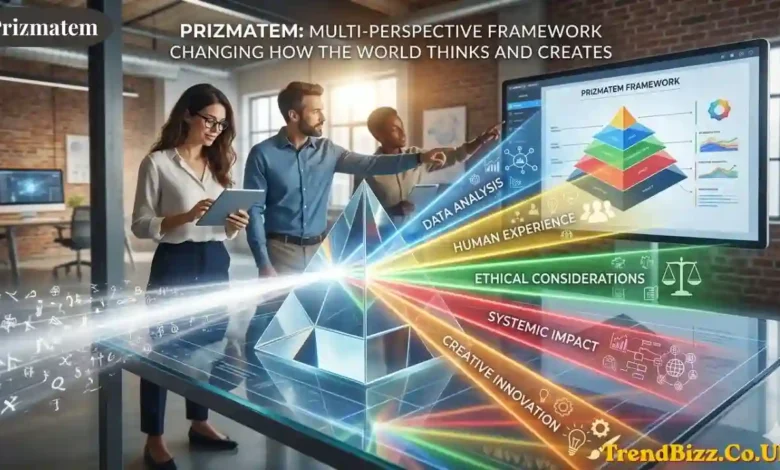
In a world drowning in data and moving faster than most people can keep up with, the ability to see clearly — and from multiple angles — has never been more valuable. Most tools and systems are still built around a single lens, one perspective, one output. But what if there was a way to break that limitation? What if thinking itself could be structured like light passing through a prism — splitting into distinct, brilliant layers of insight?
That is precisely the idea behind Prizmatem. Part philosophy, part technology, and entirely forward-thinking, Prizmatem is a concept and framework designed to help individuals, teams, and organizations cut through complexity by looking at problems from multiple perspectives simultaneously. In an age of information overload and rapid innovation, single-dimensional thinking simply does not cut it anymore. Prizmatem offers something different — a structured, flexible, and genuinely creative approach to understanding the world.
What Is Prizmatem?
At its most fundamental level, Prizmatem is a multi-perspective framework — a structured way to uncover clarity and innovation by approaching any idea, challenge, or dataset from several angles at once, much like how a prism separates white light into a full spectrum of colors.
The name itself is telling. It brings together two core ideas: the “prism,” which symbolizes clarity, diversity, and the revelation of hidden details, and “system” (or in some interpretations, “theorem” or “totem”), which represents organization, logic, and structure. When those two ideas are merged, the result is Prizmatem — a disciplined yet imaginative way of thinking and operating.
What separates Prizmatem from conventional approaches is this refusal to stay confined to a single focus. Most traditional platforms, tools, and thought frameworks are built to do one thing very well. Prizmatem, on the other hand, is designed to do many things in concert. It works as both a conceptual mindset and a tangible technology framework, making it applicable across wildly different industries and use cases. Whether someone is a designer trying to solve a creative block, a developer building a smarter interface, or a business leader navigating a difficult decision, Prizmatem gives them a way to see what they might otherwise miss.
The Origin and Philosophy of Prizmatem
The story of Prizmatem begins with a simple but powerful frustration. Too many platforms, tools, and systems were built around narrow topics or rigid structures. Life — and the challenges that come with it — is far more colorful than that. Prizmatem was born from the belief that inspiration comes from many different places, and that a truly useful framework should reflect that richness.
The core philosophy is elegant: creativity plus structure equals insight. Prizmatem does not ask people to choose between imagination and logic. Instead, it offers a space where both can coexist and reinforce each other. That is what makes it genuinely different.
At its heart, the framework addresses one of the most persistent problems in modern thinking — tunnel vision. Whether in individuals, teams, or entire organizations, the tendency to view a problem from only one angle leads to blind spots, missed opportunities, and poor decisions. Prizmatem pushes back against that tendency directly. Rather than relying on one-sided thinking, it promotes a multi-dimensional approach, examining every issue from several angles before drawing conclusions. The result is not just better answers — it is better questions.
How Prizmatem Works: The Technical Framework
For those who want to go beyond the philosophy and understand the mechanics, Prizmatem is built on a sophisticated three-tiered architecture that makes its multi-perspective approach functional in real-world digital environments.
The first tier is the Photon Integration Layer (PIL). This layer is responsible for converting raw data into visual-light patterns — essentially translating complex information into something that can be processed and understood across multiple dimensions at once.
The second tier is the Semantic Core Engine (SCE). This is where artificial intelligence enters the picture. The SCE uses AI to interpret user behavior, identifying patterns, preferences, and intent in ways that go far beyond simple command-response logic.
The third tier is the Modular Execution Channels (MEC). This layer breaks tasks down into their component parts, allowing the system to handle complex, multi-step operations without losing coherence or speed.
Together, these three layers make Prizmatem something genuinely rare: an interaction intelligence engine. It does not simply wait for instructions. It reads environmental signals, cross-references behavioral patterns, and dynamically reconfigures itself to reduce friction at every touchpoint. In practical terms, this means users experience a system that feels intuitive — almost as if it already knows what they need before they ask. Real-time adaptability is one of Prizmatem’s most distinctive qualities, and it is what separates it from legacy systems that require constant manual input and adjustment.
Key Features and Capabilities
Part of what makes Prizmatem so compelling is the breadth of its feature set. It is not built around a single capability — it is built around a layered ecosystem of capabilities that work together.
Multi-Dimensional Input Processing is one of the framework’s standout features. Rather than relying on a single input method, Prizmatem can process gesture, voice, biometric, and contextual signals simultaneously. This gives it an unusually rich picture of user intent and environment.
Collaborative Functionality is another area where Prizmatem shines. Its interface is designed to be intuitive from the start, and it integrates real-time feedback from team members seamlessly. For creative teams especially, this means faster iteration cycles and fewer bottlenecks in the review process.
Adaptive Learning takes things a step further. The system does not stay static — it learns from every interaction, gradually becoming more accurate and more responsive over time. The more it is used, the smarter it gets.
Finally, Modular Design means that Prizmatem is not locked into any single industry or application. Its architecture can be adapted and applied across vastly different contexts, from healthcare to education to smart home technology — a quality that makes it unusually versatile.
Applications Across Industries
One of the most exciting things about Prizmatem is how broadly it applies. Its multi-layered approach is not just useful in one domain — it translates across industries in meaningful ways.
Creative and Design is arguably where Prizmatem feels most at home. The platform empowers creators to express their ideas without running into the usual technical or collaborative barriers. It fosters experimentation, encourages iteration, and makes the entire design process more fluid and dynamic.
Technology and Development is another natural fit. Developers working on user interfaces benefit enormously from Prizmatem’s pattern recognition and behavioral analytics capabilities. Building interfaces that actually respond to how people behave — rather than just how they are supposed to behave — produces dramatically better user experiences.
Healthcare is a less obvious but equally important application. In clinical and research settings, data clarity can be the difference between a good decision and a costly mistake. Prizmatem’s ability to break down complex datasets into clear, interpretable layers is genuinely valuable here.
Education benefits too. Whether in a classroom, a training program, or a self-directed learning environment, the framework’s emphasis on multi-perspective thinking naturally supports deeper understanding. It does not just deliver information — it encourages people to see the full picture.
Smart Homes and IoT round out the picture. As connected devices continue to multiply, the need for seamless, intelligent communication between them becomes more urgent. Prizmatem’s architecture is well-suited to managing those complex, real-time interactions without adding friction for the end user.
Prizmatem vs. Traditional Approaches
To understand what makes Prizmatem genuinely different, it helps to put it side by side with traditional approaches.
| Feature | Traditional Tools | Prizmatem |
|---|---|---|
| Input processing | Single-mode | Multi-dimensional |
| Adaptability | Static or manual | Real-time, AI-driven |
| Collaboration | Add-on or separate | Built-in, seamless |
| Data interpretation | Surface-level | Multi-layered |
| Cross-industry use | Niche-specific | Modular and flexible |
Legacy systems tend to suffer from three common problems: siloed data that cannot communicate across platforms, slow adaptation that requires manual updates, and rigid interfaces that do not respond to individual behavior. Prizmatem addresses all three directly.
The contrast is especially clear in visual technology. Traditional smart glass, for example, offers adjustable tinting and transparency — useful, but limited. Prizmatem goes further by incorporating advanced photonic concepts that change how light actually interacts with surfaces, enabling a much richer range of visual and interactive possibilities.
The deeper advantage, though, is context-awareness. Traditional command-response models wait to be told what to do. Prizmatem reads the context around a user and responds before the need is even fully articulated. That shift — from reactive to proactive — changes the entire experience of using a system.
Benefits of Adopting Prizmatem Thinking
Beyond the technical features, adopting Prizmatem as a thinking framework carries real, practical benefits.
The most immediate is the elimination of tunnel vision. When individuals and teams are encouraged to look at a problem from multiple angles simultaneously, they catch things they would otherwise miss. That alone can prevent costly mistakes and spark unexpected solutions.
Faster, better-informed decisions follow naturally. When more perspectives are integrated into the decision-making process — and when the data supporting those perspectives is presented clearly — the quality of choices improves measurably.
Innovation without chaos is another key benefit. Prizmatem does not just encourage creative thinking; it channels it. The structure built into the framework ensures that experimentation leads somewhere productive rather than drifting into endless ideation with no output.
It is also worth noting how Prizmatem redefines creativity itself. Creativity, in this context, is not limited to art or design. It is problem-solving. It is the willingness to try a new approach when the old one is not working. It is the courage to challenge assumptions. Prizmatem gives that kind of creativity a home — and a structure to grow within.
Finally, the framework is scalable. Whether someone is working on a small personal project or leading an enterprise-wide transformation, Prizmatem’s modular design means it can grow and adapt alongside the work.
Challenges and Limitations
No framework is perfect, and Prizmatem is no exception. It is worth being honest about the areas where users might encounter friction.
For first-time users, there is a learning curve. The multi-layered approach that makes Prizmatem powerful also means there is more to understand before everything clicks into place. For teams used to simpler, single-focus tools, the onboarding period can feel demanding.
Integration with legacy systems is another real challenge. Many organizations are working with existing infrastructure that was not built with frameworks like Prizmatem in mind. Getting the two to work together smoothly often requires additional development effort.
There is also the question of over-reliance on automated behavioral analytics. When a system learns from user behavior and adapts accordingly, there is a risk that it reinforces existing patterns rather than challenging them. Over time, that could subtly limit the very multi-perspective thinking Prizmatem is meant to promote.
Finally, ethical considerations around biometric and behavioral data collection deserve serious attention. Any system that reads user behavior at this level of depth must be built and governed with strong privacy protections — and users should always know what data is being collected and how it is used.
The Future of Prizmatem
Looking ahead, the trajectory for Prizmatem is genuinely exciting. As artificial intelligence, augmented reality, and virtual reality continue to mature, the opportunities for a framework built around real-time, multi-perspective interaction multiply rapidly.
In AI, Prizmatem’s behavioral analytics capabilities are likely to become even more powerful as the underlying models grow more sophisticated. In AR and VR, its ability to process multiple input types simultaneously makes it a natural fit for immersive, adaptive experiences that respond to users in real time.
Its commitment to staying ahead of trends ensures that users will continue to have access to cutting-edge resources — which is particularly meaningful for creatives and innovators who depend on their tools to keep pace with their ambitions.
Perhaps most significantly, Prizmatem is increasingly becoming a platform — not just a product. As its ecosystem opens up to third-party developers, the possibilities expand further. Builders who understand the framework’s architecture will be able to create new applications and integrations that extend Prizmatem’s reach into domains its original designers may not have imagined.
The role of Prizmatem in shaping how humans and machines interact is only going to grow. In a future where technology is woven into nearly every aspect of daily life, having a framework that prioritizes context, adaptability, and multi-dimensional thinking is not a nice-to-have — it is essential.
Conclusion
Prizmatem is not a single thing. It is a mindset and a machine. It is a philosophy and an architecture. It is a creative space and a technical framework. That combination — rare in any tool or concept — is exactly what makes it worth understanding and worth adopting.
For creatives, it offers a platform that moves as fast as their ideas. For developers, it offers a system that anticipates rather than reacts. For educators and business leaders, it offers a way of thinking that leads to clearer, more well-rounded conclusions.
In a world defined by complexity, the most valuable capability anyone can develop is the ability to see clearly — and from more than one angle. Prizmatem makes that possible. Whether someone is exploring it as a creative tool, a technological platform, or simply a new way of approaching problems, the invitation is open: look through the prism, and see what becomes visible.
Also Read: Linkrify Review: The All-in-One Bio Link & SEO Tool Platform Explained