
SOA OS23: The Modern Enterprise Architecture Framework Built for the Future
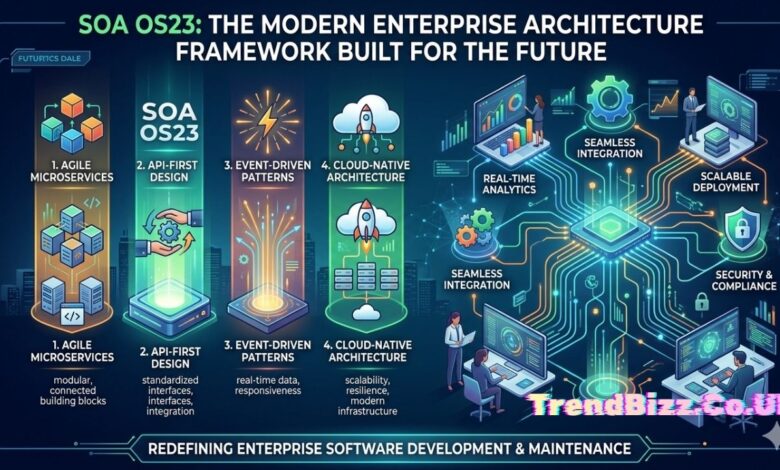
Building software that is fast, secure, and easy to scale has never been more challenging — or more important. Businesses today operate in environments that demand instant updates, seamless integrations, and resilience against failure. That is exactly where SOA OS23 steps in. It is not just another buzzword. It is a practical, modern framework that is quietly redefining the way enterprise software gets built, deployed, and maintained.
Whether someone is a seasoned software architect, a cloud engineer, or an IT decision-maker trying to future-proof their organization, understanding soa os23 is quickly becoming a must. This guide breaks down everything — from what it is and why it matters, to how it works and where it shines most.
Background: Understanding the Foundations
What is Service-Oriented Architecture (SOA)?
Before diving into soa os23, it helps to understand where it all began. Service-Oriented Architecture, or SOA, is a software design approach built around three core principles: reusability, interoperability, and loose coupling.
In traditional enterprise environments, SOA worked by dividing large systems into distinct services that communicated over a network using standardized protocols. Instead of building one giant application that did everything, teams could create individual services — one for billing, one for authentication, one for reporting — and have them talk to each other.
It was a smart idea, but it came with real limitations. Classic SOA often relied on heavy integration layers like Enterprise Service Buses (ESBs), which created bottlenecks. Release cycles were painfully slow, and updating one part of the system often meant putting the entire organization on alert. It worked, but it did not work well enough for the speed modern businesses require.
The Evolution to SOA OS23
That is where soa os23 comes in. It takes the best ideas from traditional SOA and combines them with everything that makes modern software development powerful — API-first contracts, containers, Kubernetes, and zero-trust security. Think of it as SOA that grew up.
The shift from monolithic architectures to modular microservices is at the heart of this evolution. Instead of patching together a slow, tangled system, soa os23 encourages teams to build small, independent services that can be deployed, updated, and scaled without disturbing everything else. Cloud computing and artificial intelligence have played a major role in making this possible. Together, they have created an environment where soa os23 can thrive — and where businesses that adopt it gain a serious competitive edge.
Core Features of SOA OS23
Modular Microservices Design
One of the most defining characteristics of soa os23 is its modular approach. Large software systems are broken down into smaller, focused services — each one responsible for a specific task. One service might handle user login, another manages payments, and another tracks inventory. These services communicate with each other through APIs, keeping everything connected without creating unhealthy dependencies.
The real benefit here is independence. A team can deploy one service in a container, roll it forward, or roll it back without disturbing unrelated parts of the application. That kind of agility is nearly impossible to achieve in a traditional monolithic system.
API-First Architecture
In the world of SOA OS23, APIs are not an afterthought — they are the foundation. Every service exposes its functionality through well-documented APIs, making integration seamless both internally and externally. RESTful APIs, GraphQL, and gRPC are the most commonly used interfaces, each suited to different scenarios depending on speed, flexibility, and compatibility requirements.
API versioning, gateways, and traffic management all play important roles here. A well-configured API gateway handles authentication, rate limiting, and routing, reducing the complexity that individual services would otherwise need to manage on their own.
Cloud-Native Compatibility
soa os23 was built with the cloud in mind from day one. It supports deployment across major cloud platforms including AWS, Azure, Google Cloud, and private cloud environments. Services are containerized using Docker and orchestrated with Kubernetes, which means the system can achieve high availability, self-healing behavior, and auto-scaling with minimal manual intervention.
This cloud-native DNA is one of the biggest differences between soa os23 and its predecessors. Deployment is not a final step — it is a continuous, automated process built right into the architecture itself.
AI and ML Integration
Perhaps one of the most exciting aspects of soa os23 is how naturally it accommodates artificial intelligence. AI and machine learning services — ranging from predictive analytics and natural language processing to image recognition and recommendation engines — can be exposed as services or embedded directly within the architecture.
This means organizations are not forced to build separate AI pipelines disconnected from their main systems. Instead, intelligence becomes just another service, working alongside everything else in a cohesive and manageable way.
Event-Driven Architecture
Real-time systems need more than just request-response communication. soa os23 addresses this by supporting event-driven patterns through tools like Apache Kafka, RabbitMQ, and NATS. These systems allow services to communicate asynchronously, which is crucial for applications that need to process large volumes of data quickly and reliably.
This capability makes soa os23 particularly well-suited for industries where real-time data processing is not a nice-to-have but a business necessity.
Zero-Trust Security
Security in soa os23 is not about building a hard wall around the perimeter and trusting everything inside. It operates on a zero-trust model, where every request is verified regardless of where it originates. User identity flows through OAuth 2.0 and OpenID Connect, service calls carry scoped claims such as JWTs, and access decisions happen per request rather than once at login.
This approach also supports compliance with major regulatory frameworks including GDPR, HIPAA, and ISO/IEC 27001, giving organizations the governance tools they need to meet international data protection standards.
Observability and Monitoring
Running a distributed system with dozens or hundreds of services requires excellent visibility. soa os23 integrates with OpenTelemetry, Prometheus, and Grafana for vendor-neutral tracing and metrics. This setup gives engineering teams clear, actionable insights into system performance without locking them into a single monitoring vendor.
Benefits of SOA OS23
The advantages of adopting soa os23 go well beyond technical elegance. Here is what organizations actually gain:
Flexibility is one of the biggest draws. Because services are independent, teams can update, replace, or improve one part of the system without triggering a full rebuild. Business requirements change fast, and soa os23 is designed to keep up.
Scalability is handled intelligently. Instead of scaling an entire application, organizations can scale only the services that need additional resources. This saves both money and compute power.
Fault Isolation is a genuine safety net. When one service fails, it does not bring down the entire system. The rest continues running, which dramatically increases overall stability and user trust.
Cost Efficiency comes from reusing existing services across different applications. There is far less redundancy, and maintenance costs drop over time as well-designed services continue to serve multiple needs without modification.
Faster Development happens naturally when teams can work in parallel on separate services. Combined with CI/CD pipelines, this means features get shipped faster and with less risk.
Real-World Use Cases
Healthcare
In healthcare, soa os23 enables medical records, diagnostic tools, and AI-powered disease prediction models to work together as secure, governed services. This approach improves interoperability across providers and puts patient-centered care at the center of every system decision. Data flows between the right places, when it needs to, with the appropriate security controls in place.
Banking & Financial Services
Banks have some of the most demanding integration requirements in any industry. soa os23 allows institutions to connect loan processing, customer verification, and payment services in a way that is both secure and scalable. As transaction volumes grow and regulations evolve, the architecture grows with them without requiring a full system overhaul.
E-Commerce & Retail
Online retailers depend on speed, personalization, and security. With soa os23, recommendation engines, search optimization tools, and fraud detection models can all be deployed as microservices that communicate seamlessly with user profile data and transaction systems. The result is a personalized, secure shopping experience that can handle millions of users simultaneously.
Smart Cities & Government
Public infrastructure like traffic monitoring, emergency response systems, and utility management can all be built as interoperable services under the soa os23 framework. AI enhances decision-making across all of these platforms, helping cities respond faster, manage resources better, and keep citizens more informed and engaged.
Legacy Modernization
Not every organization can afford to throw out its existing systems and start fresh. soa os23 makes gradual modernization possible. Monolithic applications can be broken down piece by piece, with core functionalities extracted and containerized as microservices. Over time, the old system gives way to a modern, maintainable architecture — without the chaos of a big-bang migration.
Challenges and Considerations
Adopting SOA OS23 is not without its hurdles. Teams should go in with clear expectations.
Implementation Complexity is real. Changing to a distributed architecture requires both new tooling and a cultural shift within engineering teams. Everyone needs to be aligned on how services are designed, deployed, and managed.
Service Governance becomes more demanding as the number of services grows. Without proper governance tools and processes, maintaining consistency across services quickly becomes chaotic.
Security Surface Area expands with every new service added. More services mean more entry points, and each one needs to be secured properly from day one.
Integration Complexity should not be underestimated. Connecting multiple services requires careful API design, well-enforced contracts, and thorough documentation. Poorly designed integrations become technical debt very quickly.
Skill Requirements are higher than in traditional architectures. Developers working within soa os23 need to be comfortable with microservices, cloud systems, and AI integrations — skills that not every team has from the start.
Testing and Debugging across distributed services is more complex than testing a single application. End-to-end testing, service mocking, and good observability tooling all become essential parts of the workflow.
Best Practices for Implementation
Teams that get the most out of soa os23 tend to follow a few consistent principles.
Starting small is almost always the right move. Beginning with one or two business capabilities — such as authentication, checkout, or notifications — allows teams to build confidence and establish patterns before expanding the architecture.
API contracts should be defined first, versioned properly, and enforced at the gateway. This reduces coupling between services and makes it far easier to integrate across different systems over time.
Infrastructure automation and CI/CD pipelines should be set up from the very beginning, not added later. Treating deployment as a continuous process rather than a milestone changes the entire development culture for the better.
Monitoring tools should track system performance at both the service and system level. Using observability standards like OpenTelemetry ensures the team is not locked into a single vendor as the architecture evolves.
Security should be implemented from the start, not bolted on after the fact. Strong access controls, encrypted service communication, and per-request authorization are all foundational — not optional extras.
Building with open standards and vendor neutrality in mind protects the organization from lock-in and keeps future options open.
SOA OS23 vs. Traditional SOA: A Comparison
| Feature | Traditional SOA | SOA OS23 |
|---|---|---|
| Deployment | Manual / On-Premise | Cloud-Native, Containerized |
| Communication | SOAP / ESB | REST, GraphQL, gRPC, Event-Driven |
| Scalability | Limited | Auto-Scaling with Kubernetes |
| AI Integration | None | Native |
| Security | Perimeter-Based | Zero-Trust |
| Release Cycle | Slow | DevOps / CI-CD |
The comparison makes it clear that soa os23 is not just an incremental improvement. It is a fundamentally different approach to how enterprise software gets built and operated.
The Future of SOA OS23
As more organizations move toward cloud-ready, distributed infrastructure, soa os23 will continue to grow in importance. It is not a trend that is likely to fade — it is a direction that aligns with where the entire industry is heading.
The convergence of soa os23 with edge computing and the Internet of Things is already beginning to take shape. As more devices generate data at the edge of networks, the ability to deploy lightweight, responsive services closer to where that data originates becomes increasingly valuable.
Looking further ahead, AI-driven autonomous service orchestration is on the horizon. Systems that can detect demand, spin up services, route traffic, and heal themselves without human intervention represent the next frontier — and soa os23 is the architectural foundation that makes that future possible.
Conclusion
Soa os23 offers something genuinely valuable: a thoughtful, modern framework for building software that is flexible, scalable, secure, and intelligent. It brings together the best ideas from service-oriented architecture, microservices, cloud computing, and AI — and packages them in a way that real engineering teams can actually implement.
For architects designing the next generation of enterprise systems, for developers tired of fighting with monolithic codebases, and for IT leaders trying to build infrastructure that will last — soa os23 deserves serious attention.
The best time to start exploring it is now. Begin with a single service. Define a clean API contract. Automate the deployment pipeline. And build from there.
Also Read: Cloth Cutting Machine and Pattern Cutting Courses: A Complete Guide for Fashion and Textile Learning