What Kinervus Is, How It Works, and Why It Matters
Every movement a person makes — reaching for a glass, standing up from a chair, taking a step — begins not in the muscles, but in the brain. The nervous system sends a signal, which travels through the spinal cord, and the muscles respond. It looks effortless. But for millions of people living with neurological conditions, injuries, or chronic disconnection between mind and body, that chain of communication breaks down. And when it does, ordinary movement becomes a serious challenge.
That is exactly the problem Kinervus was built to address.
Kinervus sits at the intersection of movement science and neurology — a concept, a clinical approach, and a growing framework that is reshaping how rehabilitation and human performance are understood. This guide breaks down what Kinervus really means, where it came from, the science that supports it, and who stands to benefit from it most.
What Is Kinervus?
The word itself tells part of the story. Kinervus is formed from two distinct roots: kinesiology, the scientific study of human movement and physical activity, and nervus, the Latin word for nerve. Put them together and the meaning becomes clear — movement governed, guided, and restored through the nervous system.
In practice, Kinervus has two overlapping identities. The first is a real physiotherapy and neurological rehabilitation practice based in Alken, Belgium. The second is a broader conceptual framework that has gained traction in wellness, performance, and technology circles — used to describe any approach that treats movement as a fundamentally neurological process rather than a purely muscular one.
Both uses share the same core idea: the body cannot move well unless the nervous system is working well. Kinervus, in either sense, is about making sure that relationship functions as it should.
The Science Behind the Concept
To understand why Kinervus matters, it helps to understand what it is responding to.
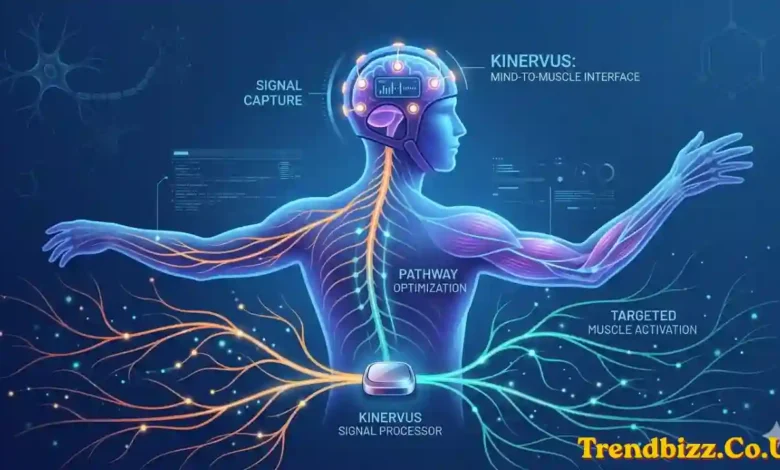
The human body’s movement system is a communication network. The brain generates a movement intention, sends that signal down the spinal cord, and delivers it through the peripheral nerves to the appropriate muscles. Those muscles contract, produce movement, and send feedback back up the chain. The whole process happens in milliseconds, thousands of times per day, without conscious effort.
When injury or disease interrupts that network — whether through a stroke, a spinal cord injury, a traumatic brain injury, or a progressive condition like Parkinson’s disease — the signal breaks down somewhere along the route. The muscle might still be intact. The limb might still be physically capable of movement. But without the neural signal to activate it properly, function is lost.
This is where conventional rehabilitation has often fallen short. Approaches focused purely on muscle strengthening can improve physical capacity without restoring the underlying neural communication. The body gets stronger on paper, but the quality of movement and the long-term recovery remain limited.
Kinervus takes a different starting point. Rather than treating the muscle as the primary target, it targets the communication pathway itself — retraining the nervous system so the brain and body can speak to each other again with clarity and precision. Research in neuroplasticity, the brain’s ability to reorganize and form new connections, supports this approach strongly. The nervous system is not fixed after injury. With the right stimulation and repetition, new neural pathways can be built, old ones can be reinforced, and function that seemed permanently lost can be recovered.
Kinervus as a Rehabilitation Approach
The clinical application of Kinervus is rooted in European rehabilitation research, with a particular foundation in Alken, Belgium. A key figure in shaping the Kinervus framework was rehabilitation specialist Stefanie Ver Eecken, whose work emphasized something that had often been missing from rehabilitation models: individuality.
Generic protocols have their place, but neurological recovery is not a one-size-fits-all process. Every patient brings a unique neurological profile, a different set of functional goals, and a personal pace of recovery. The Kinervus approach was designed to reflect that reality — beginning with a thorough diagnostic assessment to establish baseline function, and then building a treatment plan tailored specifically to that individual’s needs and targets.
In practice, clinics applying the Kinervus framework use a combination of movement science, manual therapy techniques, neuromuscular re-education, and continuous progress tracking. Treatment is not static. As the patient’s function changes, the protocol adapts. Progress is measured, documented, and used to refine the approach in real time.
The conditions that Kinervus addresses are wide-ranging. Stroke survivors working to regain limb control, individuals with Parkinson’s disease managing movement instability, patients recovering from traumatic brain injury, and people living with spinal cord injuries have all found meaningful improvement through this approach. What they share is the need for neural communication to be rebuilt — and that is precisely what Kinervus is designed to do.
Kinervus as a Broader Wellness and Performance Concept
Beyond the clinic walls, the Kinervus concept has found an audience in personal development, performance optimization, and technology.
In these contexts, Kinervus describes an integrated approach to human functioning — one that connects cognitive resilience, emotional balance, and physical performance as parts of a single system rather than separate concerns. The concept challenges the traditional separation between body and mind, arguing that peak performance in any domain depends on all three dimensions working in coordination.
This framing has resonated in productivity circles, where the demands of modern working life — high cognitive output, sustained focus, adaptability under pressure — mirror the same principles that underpin neurological rehabilitation. The same neural communication pathways that are retrained in stroke recovery are also the ones that determine how well someone performs under stress, manages emotional load, or sustains physical effort over time.
In technology, Kinervus has been used as a conceptual lens for human-machine interaction — particularly in systems that respond to neural input or aim to support movement through intelligent feedback. The word carries a quality that many emerging fields find useful: it feels grounded in biology while pointing toward the future.
Who Can Benefit from Kinervus?
The honest answer is that the potential reach of Kinervus is broad.
People recovering from neurological conditions — strokes, brain injuries, Parkinson’s disease, spinal cord damage — represent the most direct beneficiaries, particularly through clinical application of the framework. For them, Kinervus offers a recovery model that takes their nervous system seriously as the site of both the problem and the solution.
Athletes and high-performance individuals seeking a more sophisticated understanding of movement and mind-body coordination will also find the concept valuable. When movement is understood as a neurological process, training and recovery take on a different character — more precise, more targeted, and more sustainable.
Anyone with a general interest in how the brain and body communicate — whether through a health lens, a performance lens, or simple curiosity — will find Kinervus a rewarding area to explore. It sits at a crossroads of neuroscience, physiotherapy, and human potential in a way that makes it genuinely relevant across many different life contexts.
What to Expect and Key Takeaways
At its core, Kinervus rests on a simple but powerful idea: that movement is a neurological event, and that restoring or optimizing movement means working with the nervous system, not around it.
For someone exploring Kinervus clinically, the starting point is a proper diagnostic assessment from a qualified rehabilitation professional — someone trained to evaluate neural communication and build a personalized recovery plan. For those approaching it from a wellness or performance angle, the first step is understanding the brain-body connection more deeply and identifying where the weakest link in that chain might be.
The concept is still gaining mainstream recognition, but the trajectory is clear. As neuroscience advances, as rehabilitation science becomes more precise, and as performance culture grows more sophisticated, the principles at the heart of Kinervus are only going to become more relevant. It is a framework built on solid science, applied with genuine care for the individual, and pointed firmly toward the future of human health and performance.
Conclusion
Kinervus bridges two fields that have too often been treated separately: movement science and neurology. Whether it is helping a stroke survivor regain the use of their arm, supporting a person with Parkinson’s disease in maintaining their independence, or giving a high-performance professional the tools to operate at their best under pressure, the underlying philosophy remains the same. The body moves because the brain tells it to. When that relationship is healthy, movement flows. When it is not, Kinervus offers a path to restore it.
For anyone curious about how the brain and body really work together — and how that relationship can be strengthened, repaired, or optimized — Kinervus is a concept well worth exploring.
Frequently Asked Questions
What does the word Kinervus mean?
Kinervus combines kinesiology, the study of human movement, with nervus, the Latin word for nerve. The name reflects its central focus: movement guided and restored through the nervous system.
Is Kinervus a real medical treatment?
Yes. Kinervus refers to a real physiotherapy and neurological rehabilitation approach practiced at a clinic in Alken, Belgium. It is grounded in movement science and neuroscience, and is used to treat a range of neurological conditions including stroke and Parkinson’s disease.
Where did Kinervus originate?
Kinervus has its roots in European rehabilitation research, with particular development in Alken, Belgium. Rehabilitation specialist Stefanie Ver Eecken played a significant role in shaping the patient-centered philosophy that defines the approach.
Who is Kinervus suitable for?
Kinervus is most directly suited to individuals recovering from neurological conditions such as stroke, traumatic brain injury, Parkinson’s disease, or spinal cord injury. More broadly, it is relevant for athletes, high-performance individuals, and anyone interested in optimizing brain-body communication.
How is Kinervus different from regular physiotherapy?
Conventional physiotherapy often focuses on building muscle strength and improving physical capacity. Kinervus goes further by targeting the neural communication pathways themselves — retraining the nervous system so that the brain and muscles can coordinate more effectively and recovery is more durable.
Also Read: Root Canal Dentist and Teeth Whitening: Complete Guide to Modern Dental Care and Smile Restoration