Kate Andrews: The American Journalist Shaping Economic Debate on Both Sides of the Atlantic
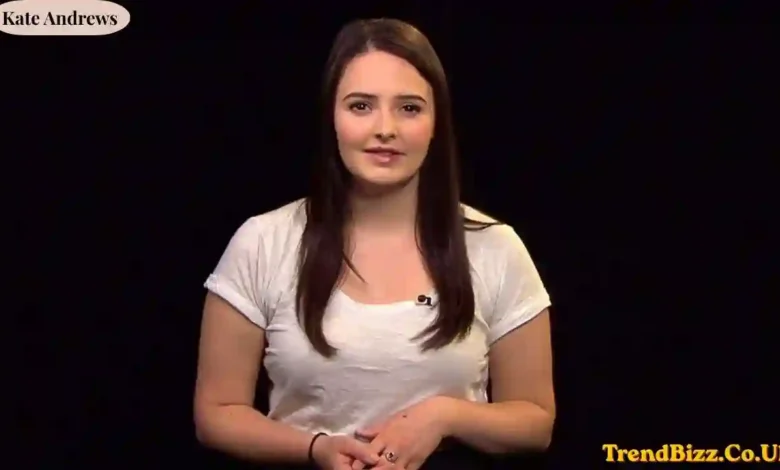
Who Is Kate Andrews?
If you’ve been following UK economic commentary over the past few years, chances are you’ve come across the name Kate Andrews. A Kate Andrews journalist profile reads like a textbook example of ambition meeting opportunity. She is an American-born writer and commentator who has carved out a highly respected space in British media, specializing in economics, public policy, and political commentary. Whether she’s appearing on a BBC panel, filing a column for a national newspaper, or breaking down a budget on live television, Kate Andrews brings a clarity and confidence to economic journalism that is hard to find.
As the Kate Andrews biography continues to grow with new chapters — from The Spectator to The Washington Post — she stands as a genuinely influential figure in transatlantic media. This piece takes a friendly but thorough look at who she is, where she comes from, and what makes her work stand out.
Kate Andrews: Basic Identity & Background
Full Name: Kate Andrews | Date of Birth: June 24, 1990 | Age: 35 | Nationality: American | Based In: United Kingdom
Kate Andrews age is 35 years old, born on June 24, 1990. She grew up in Connecticut, in the United States, before later making the move to the United Kingdom — a transition that would come to define much of her professional identity. While she remains American by nationality, her career, her commentary, and her cultural footprint are deeply rooted in the British media landscape.
For those searching “where is Kate Andrews from,” the simple answer is Connecticut, USA. But in many ways, the fuller answer is that she belongs to both sides of the Atlantic — a genuinely transatlantic voice who brings an outsider’s perspective to British economic and political life, while remaining fully embedded in its institutions and debates.
Education and Early Formation
Kate Andrews parents raised her in Westport, Connecticut, where she attended Greens Farms Academy, a well-regarded independent school. It was there that her early curiosity about politics and ideas began to take shape. After completing her schooling, she made a significant move — crossing the Atlantic to Scotland, where she enrolled at the University of St Andrews in 2008.
At St Andrews, she earned a Master of Arts in International Relations and Philosophy in 2012. It’s a pairing of disciplines that would go on to define her journalistic voice — rigorous in argument, broad in perspective, and always grounded in real-world consequence. During her time at the university, she was also involved in the performing arts society and served as rector’s assessor during Alistair Moffat’s tenure, showing a well-rounded engagement with campus life beyond academics.
Career Timeline: From Politics to Journalism
Early Career in Politics and Think Tanks
After graduating, Andrews briefly worked on some notable American political campaigns — including Mitt Romney’s presidential bid and Linda McMahon’s senate campaign — as well as contributing to Townhall, a US publication. These experiences gave her a front-row seat to the mechanics of political communication and public opinion.
She then made a decisive pivot toward the world of policy and ideas. Andrews joined the Adam Smith Institute, one of the UK’s most prominent free-market think tanks based in Westminster. There, she served as Communications Manager, developing her ability to translate complex economic arguments into accessible public messaging — a skill that would serve her brilliantly in journalism.
The Spectator: Where Kate Andrews Journalism Found Its Home
The name “Kate Andrews Spectator” has become something of a familiar pairing in British media circles, and for good reason. In 2020, Andrews joined The Spectator as an economics correspondent, making the formal leap into journalism. Her timing was remarkable — joining a major publication just as the UK was navigating the economic fallout of the COVID-19 pandemic, a story that would dominate the news cycle for years.
By 2021, she was promoted to Economics Editor — a significant recognition of both her output and her influence. In that role, she regularly wrote about inflation, government spending, healthcare funding, and labor markets. Her analysis was consistently forward-looking, and her writing combined depth with genuine readability.
Kate Andrews was twice shortlisted for “Business and Finance Journalist of the Year” at The Press Awards — most notably for her early and accurate prediction of the post-pandemic inflation surge that gripped the UK economy.
The Washington Post and Beyond
Andrews later took on the role of U.S. Deputy Editor at The Spectator before making another notable career move — joining The Washington Post as an opinion journalist. This transition firmly established her transatlantic reach, giving her a platform to comment on American politics and economics for one of the world’s most-read newspapers.
Key Publications and Platforms
The Washington Post
Opinion Journalist
The Spectator
Former Economics Editor / U.S. Deputy Editor
The Daily Telegraph
Weekly Columnist
City AM
Former Fortnightly Columnist
What Kate Andrews Covers: Beats and Areas of Focus
Kate Andrews journalist coverage spans a wide and important range of topics. At the core of her work is economic policy — she writes with particular authority on inflation, government spending, healthcare funding, and labor markets. But her interests extend well beyond the purely financial. Her reporting and commentary also touches on tax policy, regulation, free markets, civil liberties, and the broader question of where the boundaries of state power should lie.
What makes her work especially useful is that it bridges the UK and the US. She covers political commentary relevant to both countries, giving readers on either side of the Atlantic genuine insight into how their economies and governments compare. This transatlantic angle is one of the things that makes her voice genuinely distinctive in a crowded media landscape.
Media Presence and Broadcast Work
Beyond her written output, Kate Andrews is a familiar and trusted face on British television and radio. She is a regular panelist on the BBC’s flagship political programmes, including Politics Live and Question Time, where she holds her own in some of the sharpest debates in British public life. She also makes frequent appearances on Sky News, Channel 4, Channel 5, and ITV.
Her broadcast presence has done a great deal to build her public profile. Where many economists and commentators can feel overly academic or jargon-heavy on television, Andrews communicates with a directness and warmth that tends to resonate with general audiences. She’s the kind of commentator who can simplify a complex point without dumbing it down — a genuinely rare skill.
Editorial Style: Clear, Authoritative, and Accessible
One of the things people consistently notice about Kate Andrews’ journalism is the quality of her writing. Her style is clear and authoritative without being intimidating. She makes complex economic topics understandable for both professionals working in the field and everyday readers who want to make sense of the headlines. She regularly uses case studies and real-world examples to anchor her arguments, making abstract policy debates feel concrete and relevant.
Andrews consistently bridges the gap between media, policy, and public understanding — which is precisely what good economic journalism should do. Her columns don’t just describe what is happening in the economy; they explain why it matters and what it means for real people.
Political Views and Ideological Leanings
Kate Andrews describes herself as a lifelong Republican, though her political journey has had some notable twists. She supported the Libertarian candidate in the 2016 US presidential election and voted for Joe Biden in 2020 as a form of protest against Donald Trump — a decision that speaks to her willingness to prioritize principle over party loyalty.
Ideologically, she aligns closely with classical liberal ideas: she is a vocal advocate for free speech, is broadly supportive of immigration, and has previously opposed certain gun control measures. Her work at the Adam Smith Institute gives some indication of where her economic instincts lie — in favour of free markets, limited regulation, and a smaller state.
That said, she is not a simple partisan figure. Her commentary on the NHS, the UK fiscal position, and transatlantic trade often challenges mainstream consensus in thoughtful, evidence-based ways rather than reflexively ideological ones.
Kate Andrews Wikipedia and Public Profile
For those looking up Kate Andrews Wikipedia, her page offers a solid overview of her career and credentials. She is well-documented as a key figure in British economic journalism, and her profile has grown substantially in recent years thanks to her television appearances and high-profile columns. The Wikipedia entry reflects a career that has been built steadily and credibly, without reliance on controversy or spectacle.
Her public image is that of a serious, well-prepared journalist who does her homework — and that reputation has been earned over years of consistent, quality output across print, broadcast, and digital platforms.
Kate Andrews Husband and Personal Life
Searches for “Kate Andrews husband” reflect public curiosity about her personal life, which she has largely kept private. Andrews has not made her romantic or family life a prominent part of her public persona, which is entirely in keeping with her professional, journalism-focused public identity. What is known is that she is based in the United Kingdom and has built her life and career firmly in British public life, despite her American roots.
Why Kate Andrews Matters in Economic Journalism
At a time when economic journalism can feel either too dry for general audiences or too simplified for serious readers, Kate Andrews occupies a genuinely valuable middle ground. She takes the subject seriously without being inaccessible, and she brings a transatlantic perspective that enriches both British and American public debate.
Her career trajectory — from American political campaigner to Westminster think-tanker to one of The Spectator’s most prominent editors to a Washington Post opinion journalist — reflects both serious intellectual ability and a genuine nose for where the important arguments are being made. Whether you agree with her views or not, it’s hard to argue that economic journalism is richer for having Kate Andrews in it.
Also Read: Griff Rhys Jones: The Complete Story of a British Comedy Legend