
DOGE Software Licenses Audit HUD: How the Government Exposed Millions in IT Waste
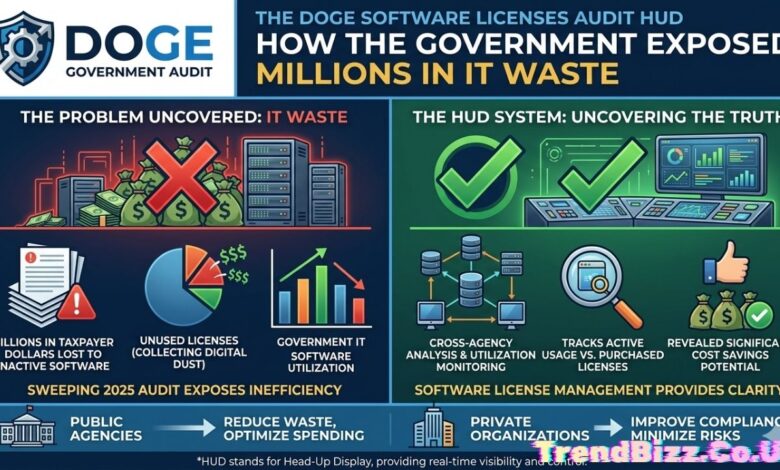
Every year, billions of taxpayer dollars flow into government IT budgets — and a surprisingly large portion of that money goes toward software that nobody is actually using. It sounds almost too careless to be true, but a sweeping audit in early 2025 proved just how real this problem is. The DOGE software licenses audit HUD became one of the most talked-about examples of government inefficiency uncovered in recent memory, revealing a staggering number of paid licenses collecting digital dust while federal agencies kept writing checks.
For IT managers, compliance professionals, and government procurement officers, this story is more than a political headline. It is a clear signal that software license management — if left unmonitored — quietly drains budgets and creates compliance risks at scale. This article breaks down what the audit found, what the “HUD” in DOGE software licenses audit HUD actually means, how the system works, and what both public agencies and private organizations can take away from it.
What Is DOGE and Why Did It Start Auditing Software?
The Department of Government Efficiency, widely known as DOGE, was established under the Trump administration in 2025 with a focused mission: identify and eliminate wasteful spending across federal agencies. Rather than making broad policy recommendations, DOGE took a hands-on approach — walking directly into agency operations, pulling data, and publishing findings publicly, often through posts on X (formerly Twitter).
From the start, DOGE made clear that its scope would be wide. It began auditing everything from staffing levels to IT contracts, and software licensing quickly emerged as a major area of concern. The logic was simple: if agencies were paying for tools that employees were not using, that represented a straightforward and fixable form of waste.
The audit process did not stop at one agency. It spread from the General Services Administration (GSA) to numerous other departments, with each round of findings revealing similar patterns — agencies holding far more software licenses than their employee count or actual usage would justify. Many of these licenses were idle, meaning they had been purchased and were actively billed but had never been installed on a single machine.
The HUD Software License Audit: What the Numbers Revealed
The Department of Housing and Urban Development, or HUD, became the most high-profile example to emerge from DOGE’s federal sweep. When DOGE posted its initial findings on March 5, 2025, the numbers were striking enough to go viral almost immediately.
The audit found that HUD had been paying for an enormous volume of software licenses that were either entirely unused or dramatically underutilized. Here is what the initial findings showed:
ServiceNow: 35,855 licenses purchased across three products, with only 84 actively in use.
Adobe Acrobat: 11,020 licenses paid for, with zero users recorded.
Cognos: 1,776 licenses held, with only 325 in use.
WestLaw Classic: 800 licenses purchased, with only 216 actively used.
Java: 10,000 licenses paid for, with only 400 users.
The gap between what was purchased and what was actually being used was not a matter of rounding errors or minor inefficiencies. In several cases, agencies were paying for tens of thousands of licenses while only a fraction of that number — sometimes in the double digits — were in active use. DOGE’s post noted that all of these issues were being addressed and fixed.
What Does “HUD” Mean in DOGE Software Licenses Audit HUD?
Here is where the terminology gets a little nuanced, and it is worth clearing up for anyone who has seen this phrase and assumed both “HUDs” refer to the same thing. In the phrase DOGE software licenses audit HUD, the second “HUD” does not always refer to the Department of Housing and Urban Development. It can also refer to a Heads-Up Display — a dashboard-style interface that provides real-time visual insight into compliance status, license usage, and cost exposure.
Think of it the way pilots use a HUD in a cockpit: instead of digging through binders and charts, they get critical data surfaced directly in their line of sight. A software license audit HUD works on the same principle. Instead of requiring IT managers to run manual reports from siloed systems or scroll through sprawling spreadsheets, a HUD presents everything on one screen — which licenses are active, which are idle, which are about to expire, and which ones are creating compliance risks.
This kind of visual, real-time monitoring is a significant upgrade over traditional static reporting. Spreadsheets go stale the moment they are exported. A live HUD, by contrast, reflects the current state of the software environment at all times, allowing teams to respond to problems before they become expensive.
How the DOGE Audit HUD System Actually Works
Understanding the mechanics behind the DOGE software licenses audit HUD helps explain why it is considered such a powerful tool for compliance and cost management. The process follows a structured sequence that takes organizations from raw data to actionable insight.
Discovery is the first phase. The system scans the entire software environment, inventorying every application, every open-source component, and every proprietary tool that has been deployed or contracted. Nothing is assumed — everything is identified from scratch.
License Identification comes next. Each piece of software is matched against a database of license metadata, categorizing it by type — whether that is MIT, GPL, Apache, proprietary, or any other licensing framework — and logging key details like version, scope, and usage terms.
Compliance Evaluation follows. The HUD then analyzes whether actual usage aligns with what has been licensed. This is where gaps become visible: licenses that were purchased but never deployed show up clearly, as do cases where usage has exceeded the licensed quantity.
Live HUD Updates keep the dashboard current. Rather than producing a one-time report, the system pushes real-time updates so that decision-makers always have an accurate picture.
Alerts and Automation kick in when thresholds are crossed. If a license is about to expire, if usage drops below a threshold, or if a compliance risk emerges, automated alerts notify the right people immediately — removing the need for manual oversight.
Reporting and Logs round out the process. The system generates audit trails that can support both internal reviews and external regulatory reporting, giving organizations a defensible record of their compliance posture at any given point in time.
Key Features of a Software License Audit HUD
A well-built software license audit HUD brings together several capabilities that individually are useful but together are transformative for IT governance.
Automated scanning removes the human bottleneck from license discovery. Instead of relying on employees to self-report what software they are using, the system finds it automatically across repositories, deployment environments, and cloud platforms.
License tracking maintains an always-current record of every license an organization holds — when it was acquired, what it covers, how many seats are authorized, and how many are in use.
Usage analytics surface the patterns that reveal waste. If 10,000 licenses have been purchased and only 400 are being used, the analytics layer makes that visible in a way that drives decisions.
Compliance alerts ensure that organizations are never caught off-guard. License expirations, usage overages, and flagged software categories all trigger notifications before they become problems.
Centralized dashboards give IT managers a single source of truth, replacing the fragmented picture that comes from managing licenses across multiple vendors, contracts, and systems.
Integration with existing infrastructure — including asset management tools and enterprise resource planning systems — ensures that the HUD works within the organization’s existing workflow rather than creating a parallel system that teams have to maintain separately.
Security controls, including encryption and access management, protect the sensitive data that passes through the audit system, ensuring that license records and usage data are only accessible to authorized personnel.
Immediate Impact: How Government Agencies Responded
The speed of the response to the DOGE software licenses audit HUD findings was notable. At GSA, the reaction was almost immediate. Within three hours of the DOGE post going live on X, GSA’s acting administrator announced that the agency was taking immediate action to reduce IT spending by $5.5 million. In the days that followed, GSA deleted 114,163 unused software licenses and removed 15 underutilized or redundant software products, resulting in annual savings of $9.6 million.
At HUD, remediation efforts followed a similar path. The licenses identified in the audit were reviewed and addressed, with the agency working to align its actual license holdings with real usage patterns. DOGE confirmed that all flagged items were being fixed.
The ripple effects spread to other federal agencies as well. The public nature of the findings created a kind of accountability that quiet internal reviews had never managed to generate. When numbers like “11,020 Acrobat licenses with zero users” are published to millions of people on social media, the pressure to act becomes immediate and impossible to ignore.
The Controversy: Where Critics Pushed Back
Not everyone viewed the DOGE software licenses audit HUD findings as straightforwardly as the headlines suggested. While supporters praised the effort as a long-overdue exposure of systemic waste, IT procurement experts raised legitimate questions about whether the framing was accurate.
The core of the counterargument is that enterprise software licensing is more complex than a simple headcount comparison. In large organizations, licenses are sometimes purchased in bulk at discounted rates that make overage coverage cost-effective. Some licenses serve as contingency reserves — available for deployment during peak periods, onboarding surges, or project expansions — and classifying them as “unused” may misrepresent their purpose.
There were also questions about DOGE’s methodology. Critics noted that the findings were shared in social media posts rather than detailed reports, which made independent verification difficult. Without visibility into how “active use” was defined or how usage data was collected, some experts argued it was hard to assess whether the numbers reflected genuine waste or normal enterprise licensing practices.
These are fair points worth considering. The debate does not invalidate the core findings — the scale of the gaps at HUD was too large to be explained entirely by contingency planning — but it does underscore the importance of context when evaluating license utilization data.
The Real Benefits of a Software License Audit HUD
Regardless of where one lands on the political dimensions of the DOGE story, the underlying case for proactive license management is strong. The benefits of implementing a software license audit HUD extend well beyond government agencies.
Simplified compliance is perhaps the most immediate benefit. Instead of trying to piece together license obligations from contracts, vendor emails, and internal spreadsheets, teams get a clear and current view of their compliance status at all times.
Improved transparency changes the dynamic between IT, legal, and finance. When all teams are looking at the same data, decisions about software procurement become better informed and easier to justify.
Cost optimization is the headline benefit that tends to get attention. Studies suggest that organizations waste up to 30% of their software budget on unused licenses. A license audit HUD makes that waste visible — and therefore addressable.
Better collaboration emerges naturally when developers, IT managers, and legal teams share a common platform. License conflicts, risky software categories, and upcoming renewals become shared knowledge rather than siloed concerns.
Reduced legal risk follows from consistent compliance monitoring. Organizations that can demonstrate ongoing awareness of their license obligations are far better positioned if a vendor initiates an audit.
Community trust matters too, especially for organizations that rely on open-source ecosystems. Demonstrating ethical software usage builds reputation within developer communities and reduces the risk of disputes.
What Private Organizations Can Learn From This
The DOGE software licenses audit HUD story is often framed as a government problem, but the underlying dynamics are universal. Any organization managing a large portfolio of software licenses — whether it is a midsize company with 500 employees or a multinational with thousands — faces the same basic risk: paying for tools that no one is using.
A real-time Software Asset Management system, or SAM, is the private-sector equivalent of what DOGE deployed at HUD. The principles are identical: discover what you have, measure what is being used, compare the two, and act on the gap.
For organizations looking to start, a few practical steps make sense. Begin with a full inventory of all software contracts currently in place. Layer in usage data from deployment tools, login systems, and endpoint management platforms. Compare the two to identify the most significant gaps. Prioritize the highest-cost, lowest-usage licenses for immediate action. Then implement a HUD-style monitoring system to ensure the gains hold over time.
Choosing the right tool matters. Look for platforms that integrate natively with the organization’s existing infrastructure, support automated discovery rather than relying on manual input, and provide dashboards that non-technical stakeholders can read and act on without needing an IT translato
The Future of Software License Auditing
The DOGE software licenses audit HUD has done something important beyond exposing specific instances of waste — it has shifted the conversation about how license management should work going forward.
The old model of periodic audits — reviewing licenses once a year or once a quarter — is increasingly inadequate in environments where software portfolios change constantly. Cloud subscriptions spin up and down. Contractors come and go. Projects end and the licenses associated with them stay active by default. Continuous compliance monitoring, enabled by always-on HUD systems, is becoming the expected standard rather than a nice-to-have.
Artificial intelligence and automation are accelerating this shift. Modern audit platforms can now detect anomalies in license usage patterns, predict upcoming waste before it accumulates, and automatically recommend optimization actions without requiring a human to run a report first.
At the policy level, the HUD findings are already influencing conversations about federal IT procurement reform. When publicly posted data shows that a single agency paid for tens of thousands of licenses it never used, the argument for more rigorous procurement standards and mandatory usage reporting becomes much harder to dismiss.
Conclusion
The DOGE software licenses audit HUD story is, at its core, a story about visibility. The waste at HUD did not happen because anyone decided to throw money away — it happened because there was no system in place to surface the gap between what was purchased and what was actually used. Nobody was watching, so nothing was caught.
The HUD findings — tens of thousands of unused licenses across products from ServiceNow to Adobe to Westlaw — are a vivid illustration of what happens when license management is treated as an administrative afterthought rather than an active governance function. The GSA’s rapid response, cutting $9.6 million in annual IT spending within days of the findings going public, shows that the fix, once the problem is visible, can be fast.
For any organization — public or private — the lesson is straightforward: proactive license governance is not optional anymore. A real-time software license audit HUD turns an invisible problem into a manageable one. It brings waste into the light, keeps compliance on track, and gives decision-makers the information they need before a vendor audit or a public report does it for them.
The question worth asking internally is simple: if someone ran this same audit on your organization tomorrow, what would the numbers show?
Also Read: SOA OS23: The Modern Enterprise Architecture Framework Built for the Future