Olivia Williams: The British Actress Who Has Always Been a Cut Above the Rest
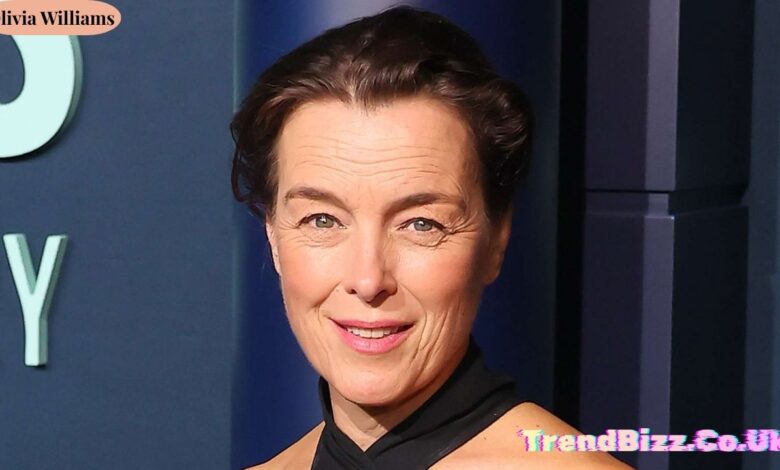
Some actors chase fame, and then some actors simply demand your attention the moment they appear on screen. Actress Olivia Williams firmly belongs to the second group. With a career spanning more than three decades across theatre, film, and television — on both sides of the Atlantic — Olivia Williams has quietly become one of the most respected and consistently compelling performers of her generation. She may not always headline a blockbuster, but when Olivia Williams is in a scene, she owns it completely.
Who Is Olivia Williams?
Olivia Haigh Williams was born on 26 July 1968 in North London, England. The daughter of two barristers, she grew up in an intellectually driven household that clearly shaped the thoughtful, intelligent energy she would later bring to every role. Before Olivia Williams ever stepped in front of a camera, she had already built an impressive academic foundation — earning a degree in English literature from the prestigious Newnham College at the University of Cambridge.
But the stage was always calling. After Cambridge, she dedicated herself fully to the craft of acting, spending two years at the Bristol Old Vic Theatre School before going on to train and perform with the Royal Shakespeare Company for three years. It was a rigorous, classical education — and it shows in every performance she gives.
Early School Days and a Famous Classmate
Here’s a fun bit of trivia that many people don’t know: Olivia Williams and Helena Bonham Carter attended the same school. Both studied at South Hampstead High School, an independent girls’ school in Hampstead, North London. Two future British screen legends sitting in the same classrooms — it’s the kind of detail that makes you wonder what the school reunions must be like.
A Theatre Career Built on Shakespeare and Substance
Long before Olivia Williams became known for her film and television work, she was a dedicated stage actress with serious classical credentials. Her work with the Royal Shakespeare Company included productions such as Misha’s Party, Wallenstein, The Broken Heart, The Wives Excuse, and Peer Gynt. Her National Theatre credits are equally impressive — Waste, Love Labour’s Lost, Happy Now?, Tartuffe, and Mosquitoes, among others.
In 1995, she toured the United States as part of the National Theatre’s production of Richard III, starring alongside the legendary Sir Ian McKellen. It was a defining period in her early career — and, as it turned out, a journey that would open unexpected doors in Hollywood.
The Breakthrough: From Stage to Screen
How Kevin Costner Spotted Her
That U.S. tour with Richard III caught the eye of Kevin Costner, who hand-picked Olivia Williams for a role in his ambitious post-apocalyptic epic The Postman (1997). While the film itself was a commercial misfire, it launched her into the world of American cinema — and things moved quickly from there.
Her first significant screen appearance had actually come a year earlier, when she played Jane Fairfax in the acclaimed British TV adaptation of Jane Austen’s Emma (1996) — a role that showcased her ability to bring literary characters to warm, believable life.
Rushmore and The Sixth Sense Change Everything
Wes Anderson’s Rushmore (1998) gave Olivia Williams one of her most memorable early roles — the quietly captivating Rosemary Cross, the teacher caught between the competing affections of a teenager (Jason Schwartzman) and his mentor (Bill Murray). It was a role that perfectly illustrated her gift for playing emotional complexity with restraint and wit.
Then came the film that introduced her to a global audience. M. Night Shyamalan’s The Sixth Sense (1999) was one of the highest-grossing films of its era, and Olivia Williams played Anna Crowe — Bruce Willis’s wife — in a performance that was subtle, warm, and ultimately heartbreaking once the film’s famous twist landed. It was, by any measure, a career-defining moment.
Olivia Williams Movies and TV Shows: A Career of Bold Choices
The 2000s: Quality Over Quantity
Following her Hollywood breakthrough, actress Olivia Williams made a series of choices that said everything about her priorities as a performer. Rather than chasing commercial blockbusters, she gravitated toward interesting, character-driven projects.
She appeared in The Body (2001) alongside Antonio Banderas, took a role in Below (2002), and starred in the major Universal Studios production of Peter Pan (2003). But it was The Heart of Me (2002) — a beautifully crafted British period drama also starring Helena Bonham Carter and Paul Bettany — that brought her real critical recognition. Her performance earned her Best Actress at the British Independent Film Awards, a well-deserved honour for a quietly devastating piece of work.
She also had an uncredited role as Dr. Moira MacTaggert in X-Men: The Last Stand (2006) — a small but notable appearance in one of the decade’s biggest franchises.
In 2007, she took on the bold challenge of portraying Jane Austen herself in the BBC film Miss Austen Regrets, followed by a standout supporting role in the Oscar-nominated An Education (2009). That one-two combination of performances caught the attention of Joss Whedon, who cast her as the commanding Adelle DeWitt in his cult Fox series Dollhouse (2009–2010) — a role that gave her the chance to anchor a television show with the kind of authority she had always brought to the stage.
The Ghost Writer: A Career Peak
If there is a single performance that crystallised just how extraordinary Olivia Williams can be, it is her role as Ruth Lang in Roman Polanski’s political thriller The Ghost Writer (2010). Playing the icy, complicated wife of a former British Prime Minister, she delivered a performance of such controlled precision and simmering tension that critics couldn’t stop talking about it.
The recognition was immediate and richly deserved. She won the National Society of Film Critics Award for Best Supporting Actress and the London Critics Circle Film Award for British Supporting Actress of the Year. She was also a runner-up for Best Supporting Actress at the Los Angeles Film Critics Association Awards. It was the kind of performance — and the kind of acclaim — that cements a legacy.
A Run of Prestigious Projects
The years following The Ghost Writer saw Olivia Williams move from one prestigious project to the next. Director Joe Wright cast her in Hanna (2011), alongside Cate Blanchett and Saoirse Ronan, and then in Anna Karenina (2012) with Keira Knightley and Jude Law. She joined an extraordinary ensemble — including Bill Murray, Olivia Colman, and Laura Linney — in Hyde Park on Hudson (2012), playing Eleanor Roosevelt with characteristic grace.
David Cronenberg then cast her in the darkly satirical Maps to the Stars (2014), and she played Lady Churchill in the warmly received Victoria & Abdul (2017), directed by Stephen Frears. Every project was a statement of intent: Olivia Williams was interested in substance, not stardom.
Television Work: Olivia Williams Owns the Small Screen Too
When it comes to Olivia Williams movies and TV shows, her television work deserves just as much attention as her film career. In The Halcyon (2017), she played Lady Priscilla Hamilton in a stylish ITV period drama set during the London Blitz. Around the same time, she took on the dual-reality spy thriller Counterpart (2017–2019) opposite J.K. Simmons — a complex, layered performance across two seasons that showcased her range in ways that few television roles could.
In The Father (2020), starring alongside Anthony Hopkins and Olivia Colman, she played Catherine — a role that, even in a film packed with extraordinary performances, she made entirely her own. She then appeared as Lavinia Bidlow in Joss Whedon’s HBO fantasy series The Nevers (2021).
Most recently, she stepped into one of the most high-profile roles of her career: Camilla Parker Bowles in Seasons 5 and 6 of Netflix’s globally beloved series The Crown. It is exactly the kind of demanding, historically resonant role that Olivia Williams handles with absolute authority. And she followed it up with an appearance as Tula Harkonnen in HBO Max’s Dune: Prophecy (2024) — proving that even after three decades, she is still expanding her horizons.
Acting Style and Legacy
What sets Olivia Williams apart from her peers? Critics have written for years about her extraordinary ability to do more with less. Even in supporting roles, she brings a depth and intelligence to her characters that is entirely out of proportion to her screen time. A single look, a carefully placed pause, a sharp intake of breath — she conveys worlds of emotional complexity without ever appearing to try too hard.
Throughout her career, she has relied on intelligence, artistry, and wit rather than spectacle. Her choices have always reflected taste and genuine discernment — a commitment to quality over convenience that has led critics to compare her to character actresses of the calibre of Maggie Smith. That is the highest kind of compliment in British acting circles, and it is richly earned.
Her career has always moved between London’s West End and Hollywood with rare ease — a testament to the classical training that underpins everything she does.
Personal Life and Advocacy
Away from the camera, Olivia Williams leads a grounded and private life. After a seven-year relationship with actor Jonathan Cake, she married actor and playwright Rhashan Stone in 2003. Together they have two daughters.
In 2018, she received a diagnosis of VIPoma — a rare and serious condition. After treatment, she channelled that experience into advocacy, becoming an ambassador for Pancreatic Cancer UK. It speaks to the same courage and purposefulness that defines her professional life: when faced with something difficult, Olivia Williams doesn’t step back. She steps forward.
Awards and Key Honours
- British Independent Film Award — Best Actress — The Heart of Me (2003)
- National Society of Film Critics Award — Best Supporting Actress — The Ghost Writer (2010)
- London Critics Circle Film Award — British Supporting Actress of the Year — The Ghost Writer (2011)
- Multiple nominations from ALFS, LAFCA, and the Empire Awards
Final Thoughts
Actress Olivia Williams is the rare kind of performer who makes every project she touches feel more serious, more intelligent, and more alive. From her classical theatre beginnings at the RSC to iconic turns in The Sixth Sense, The Ghost Writer, The Crown, and Dune: Prophecy, Olivia Williams has built one of the most quietly remarkable careers in contemporary British acting. She has never chased trends or headlines. She has simply done the work — beautifully, consistently, and on her own terms.
That, perhaps more than any award or box office number, is the real measure of what Olivia Williams actress has achieved.
Also Read: Dan Aykroyd: The Iconic Comedian, Actor, and Creative Visionary